How Alaska Sex Workers Helped Stop a Serial Killer

The Brian Steven Smith case should force Alaska to confront an ugly truth: When law
enforcement and public policy treat some people as less worthy of protection, predators get
more room to operate.
For years, women in the sex trade in Anchorage were left unprotected – and a serial killer took
advantage of that.
Season Two of Octavia Spencer’s docuseries, The Lost Women of Alaska, shows that sex
workers uncovered critical information that helped stop a serial killer. They spoke up and
relayed information, while living under the constant threat of arrest in a system that criminalizes
them for surviving.
That should shame policymakers. Instead of building trust with the very people most likely to
witness violence first, Alaska criminalizes sex workers, discredits them, and treats them as
disposable.
A year before Smith’s arrest, a woman reported to law enforcement that Smith had shown her a
video of a deceased woman being raped. She initially identified the victim as a Black prostitute.
Smith was not investigated; police felt no urgency due to the victim’s stigmatized status.

The State of Alaska wastes prosecutorial resources on prostitution charges and overcharging
people in the name of “rescue” while failing to respond to rape, disappearances, and homicides.

The killer’s interviewer, Amber Batts, was charged with sex trafficking for providing safety and
screening in the industry, while a man reported for murder was left uninvestigated. You don’t
need a policy degree to see the madness in that.

Alaska struggles to name and number its missing and murdered. These issues are connected
by the same broken approach: Target the vulnerable, ignore the warning signs, and call it public
safety.

Law enforcement leaders have fought efforts to restrict officers from having sexual contact with
sex workers and trafficking survivors during investigations, and opposed measures that would
give sex workers and sex trafficking survivors safer access to report violence.

In 2016, Alaskan sex workers won immunity to report violent crimes. In 2017, the Anchorage municipality held hearings to dispute this immunity, and law enforcement argued that the threat of prostitution
arrest needed to remain in place, even when people were trying to report serious crimes like
child pornography.

If docuseries hero Valerie had known she could report without risking arrest, she could have
given the phone directly to the police instead of moving evidence onto an SD card to avoid a
prostitution charge. What additional evidence – and other victims – might have been identified?

That is why this moment is a turning point for Alaska’s public safety.

Community United for Safety and Protection (CUSP) works for change through legislative channels, but for years has been met with a lack of political will and institutional resistance.
CUSP’s recent legal challenge argues that Alaska’s prostitution laws violate constitutional
protections, harm the citizenry, and undermine public safety. This is bigger than the legalities of
sex work.

This moment will determine whether Alaska clings to failed policies or admits that its bad
policies don’t just stigmatize people on paper – they enable serial killers. Policymakers who
want to prevent violence need to stop criminalizing the people who most often navigate it first.

You don’t have to approve of someone’s choices to want them alive.

Maxine Doogan
Amber Batts
Community United for Safety and Protection

https://www.adn.com/opinions/2026/03/24/opinion-how-alaska-sex-workers-helped-stop-a-serial-killer

Why CUSP Filed a Lawsuit Against Alaska’s Prostitution Statute

On December 22, 2025, CUSP — Community United for Safety and Protection — filed a lawsuit in Alaska Superior Court challenging the constitutionality of Alaska’s prostitution statute.

Case No.: 3AN-25-11371CI

This is a big step. Not because we love courtrooms (we don’t), but because we’re tired of watching the same cycle play out: stigma → criminalization → increased danger → silence → more harm.

This lawsuit asks the court to permanently stop enforcement of AS 11.66.100(a)(1). The law that criminalizes consensual adult sex for a fee.

We’re represented by attorney Megan M. Rowe, and the defendants named in the suit are Attorney General Stephen J. Cox and Department of Public Safety Commissioner James Cockrell in their official capacities.

So what is this actually about?

At its core, this case is about privacy, equal protection, and safety.

CUSP argues that Alaska’s prostitution statute violates the Alaska Constitution’s right to privacy (Article I, Section 22) by intruding into private, consensual adult decisions about bodily autonomy, without a compelling government reason.

We also argue it violates equal protection because the law doesn’t apply equally. In practice, this hits the people who are already the easiest to punish: people who are poor, marginalized, housing-insecure, battling addiction, trying to survive, or living under the weight of stigma that follows them everywhere.

And yes people hear “prostitution statute” and assume this is about morality.

It’s not. This is about how the law functions in real life and the reality is that criminalization doesn’t “solve” sex work. It just makes it riskier.

The part people don’t like to talk about

The complaint also raises a hard, ugly issue. What law enforcement is allowed to do in the name of investigating prostitution.

The lawsuit describes what it alleges is state-authorized sexual misconduct including investigative practices that allow undercover officers to engage in sexual acts or sexual contact with suspects to obtain evidence.

The complaint calls this state-sanctioned sexual assault and argues it shocks the conscience.

We are saying plainly. No state should be allowed to use sex as a weapon, humiliation as a tactic, and coercion as “evidence gathering.”

That shouldn’t be controversial. But here we are.

Why CUSP is doing this

CUSP exists to protect the health, safety, and dignity of people impacted by the sex trade in Alaska, including current and former sex workers and sex trafficking survivors.

We do this work because we know what criminalization does. It pushes people into isolation. It makes it harder to screen clients. It makes it harder to work together. It makes it harder to report violence. It makes it harder to ask for help because help can come with handcuffs. It kills us.

And when people can’t protect themselves openly, violence gets easier.

The lawsuit also points to research showing that decriminalization improves public health and can foster safer cooperation between workers and law enforcement. That’s what “public safety” should actually mean.

What we’re asking the court to do

We are asking the court to declare AS 11.66.100(a)(1) unconstitutional and to stop enforcement of the law.

This isn’t about creating chaos. It’s about correcting a system that creates harm and then pretends it’s protection.

Where things stand right now

Right now, we’re waiting for the other side to respond in Case No. 3AN-25-11371CI. As soon as there’s movement we can responsibly share, we’ll update the public.

Why you should care (even if you think this has nothing to do with you)

Because this case isn’t just about one law.

It’s about whether Alaska can keep using stigma as policy.


It’s about whether the state can treat certain people as disposable.


It’s about what we allow to happen to human beings under the excuse of “public safety.”

CUSP is doing this because we believe safety is a right not a reward for being respectable.

If you want to follow along, share this post, and keep up with updates, stay connected with us.

Website: sextraffickingalaska.com
Email: cuspalaska@gmail.com

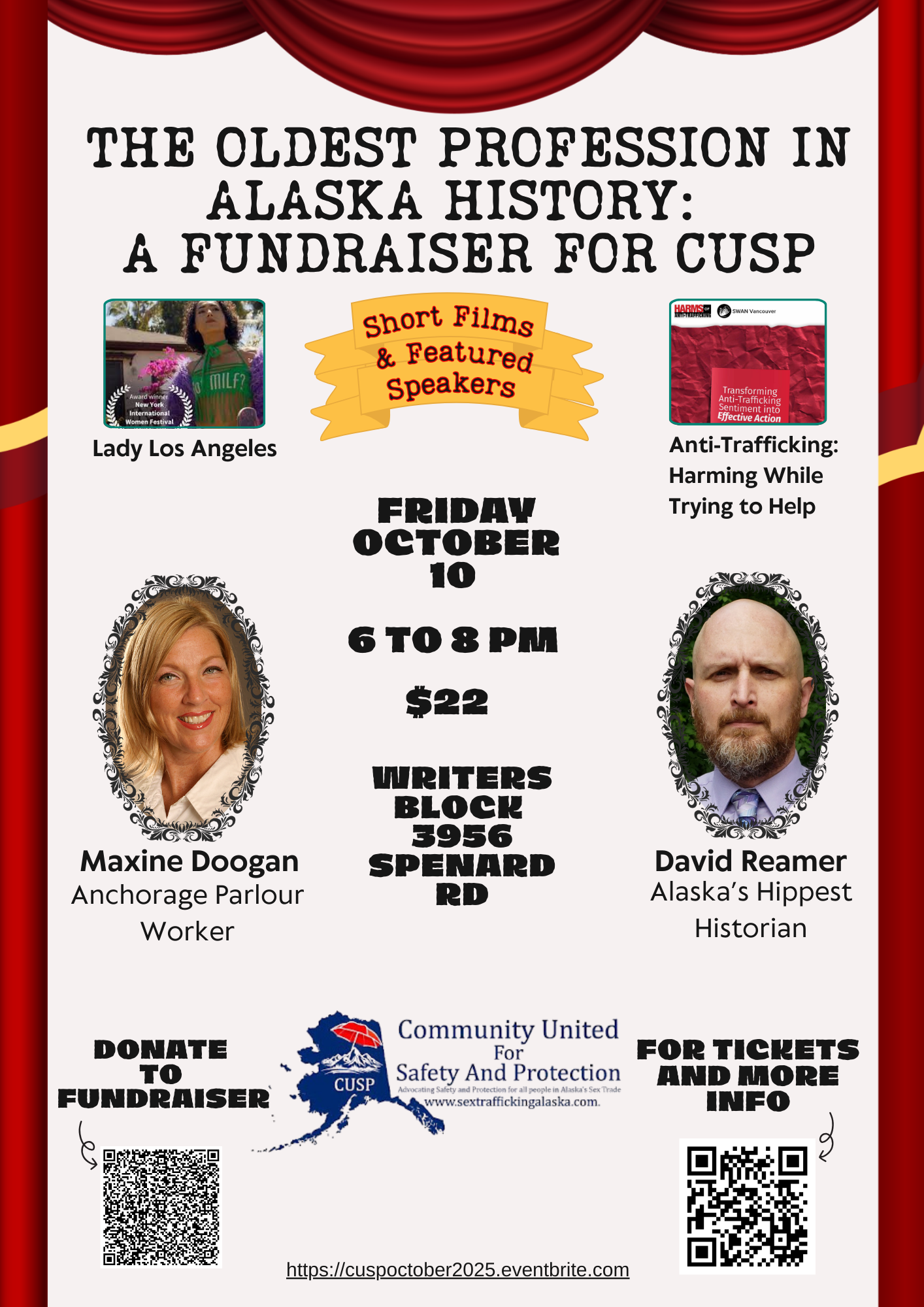
The Oldest Profession in Alaska History: A Fundraiser for CUSP

The Oldest Profession in Alaska History: A Fundraiser for CUSP

Alaska’s history is full of stories, some hidden, some forgotten, and some that demand to be told. On Friday, October 10th, from 6 to 8 PM at Writers Block (3956 Spenard Rd, Anchorage), Community United for Safety and Protection (CUSP) invites you to an evening of short films, featured speakers, and important conversation about sex work and sex trafficking survivors, history, and policy.

The Oldest Profession in Alaska History highlights the deep ties of sex workers and sex trafficking survivors to Alaska’s past, while examining policies that, instead of offering support, often harm and create struggles for the very people they claim to help. The short films and discussions will explore not only history, but also the policies that continue to shape sex workers’ lives, policies that often criminalize, stigmatize, and endanger rather than protect.

Featured Speakers & Films

  • 🎥 Lady Los Angeles – A film festival selection exploring sex work and resilience.
  • 🎥 Anti-Trafficking: Harming While Trying to Help – A powerful critique of policies that often do more damage than good.
  • 🎤 Maxine Doogan – Anchorage Parlour Worker and long-time advocate for sex worker rights.
  • 🎤 David Reamer – Alaska’s hippest historian, bringing context and insight into the broader historical picture.

Why Attend?

This event isn’t just about history and policy; it’s about justice. CUSP has long been at the forefront of advocating for the rights and safety of sex workers and sex trafficking survivors in Alaska, pushing back against harmful legislation and amplifying the voices of those too often silenced.

Mark your calendar for this event!

By attending, you’re supporting a cause that advocates for equality and protection under the law.

📅 Date: Friday, October 10
Time: 6–8 PM
📍 Location: Writers Block, 3956 Spenard Rd
💵 Tickets: $22

👉 Get your tickets and more info here.

If you can’t make it but want to support the cause, you can also donate directly using the QR code on the flyer or here.

Come for the films, stay for the conversation, and leave knowing you’ve contributed to a movement working to make Alaska a safer, fairer place for everyone.

This month, celebrate resilience and the transformative power of LGBTQ+ storytelling with Puella Aeterna: What Would Lilith Do? by Ashley Marie Lettice

Written and self-published on her phone while homeless on the beach, Ashley’s book is a testament to the sheer determination of a writer whose voice refuses to be silenced.

Puella Aeterna dives deep into themes of myth, freedom, and self-discovery, paying homage to mythic female resilience. Though Amazon hasn’t given it the spotlight it deserves, we’re excited to share this powerful work with our community.

Available on Kindle now, Puella Aeterna is a must-read for anyone supporting fearless LGBTQ+ creators.

House Bill 66 will make sex workers and sex trafficking survivors charged with working or traveling together register as sex offenders

House Bill 66 will make sex workers and sex trafficking survivors charged with working or traveling together register as sex offenders. It will be on the Senate Floor May 14th! We need your help!

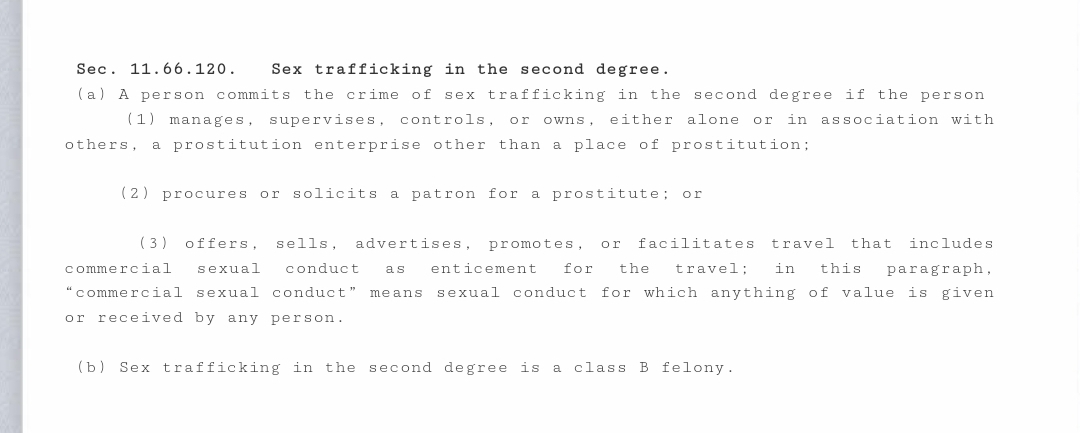
House Bill 66 was just a bad homicide/overdose bill, but just over a week ago the Senate Judiciary Committee, led by Senator Matt Claman, turned it into a 40 page criminal justice omnibus bill that does everything from allowing hearsay at grand jury to making people convicted of first and second degree sex trafficking register as sex offenders.

It makes sense for people convicted of sex trafficking in the first degree – most of that statute is what we traditionally think of as sex trafficking. Sex trafficking in the second degree is just things like sex workers traveling together or sharing clients – things that are done even more often by sex trafficking survivors than sex workers.

Here is a story about our member Amber being convicted of sex trafficking in the second degree under the travel part of the statute. More recently, a mother who was a victim of horrifically violent sex trafficking was charged in a similar way.

We need your help!

Email your opposition to all of our Alaska Senators! Ask them to vote no on HB 66 as long as Section 30 (page 24, line 9) includes Sex Trafficking in the Second Degree.

Senator.Bill.Wielechowski@akleg.gov;

Senator.Kelly.Merrick@akleg.gov;

Senator.Shelley.Hughes@akleg.gov;

Senator.David.Wilson@akleg.gov;

Senator.Bert.Stedman@akleg.gov;

Senator.Jesse.Kiehl@akleg.gov;

Senator.Gary.Stevens@akleg.gov;

Senator.Jesse.Bjorkman@akleg.gov;

Senator.Cathy.Giessel@akleg.gov;

Senator.James.Kaufman@akleg.gov;

Senator.Elvi.Gray-Jackson@akleg.gov;

Senator.matt.claman@akleg.gov;

Senator.Forrest.Dunbar@akleg.gov;

Senator.Loki.Tobin@akleg.gov;

Senator.Mike.Shower@akleg.gov;

Senator.Scott.Kawasaki@akleg.gov;

Senator.Click.Bishop@akleg.gov;

senator.robert.myers@akleg.gov;

Senator.Lyman.Hoffman@akleg.gov;

Senator.Donald.Olson@akleg.gov;

Why We Oppose House Bill 264

Please see the following short presentation that we created to explain why House Bill 264 is a bad bill for Alaskans. 

Not only would HB 264 create misleading of definitions of sex trafficking and commercial sexual exploitation in Alaska statutes, but these misleading definitions will create more barriers to evidence based policy and lead to bad laws that impact all Alaskans.