Why CUSP Filed a Lawsuit Against Alaska’s Prostitution Statute

On December 22, 2025, CUSP — Community United for Safety and Protection — filed a lawsuit in Alaska Superior Court challenging the constitutionality of Alaska’s prostitution statute.

Case No.: 3AN-25-11371CI

This is a big step. Not because we love courtrooms (we don’t), but because we’re tired of watching the same cycle play out: stigma → criminalization → increased danger → silence → more harm.

This lawsuit asks the court to permanently stop enforcement of AS 11.66.100(a)(1). The law that criminalizes consensual adult sex for a fee.

We’re represented by attorney Megan M. Rowe, and the defendants named in the suit are Attorney General Stephen J. Cox and Department of Public Safety Commissioner James Cockrell in their official capacities.

So what is this actually about?

At its core, this case is about privacy, equal protection, and safety.

CUSP argues that Alaska’s prostitution statute violates the Alaska Constitution’s right to privacy (Article I, Section 22) by intruding into private, consensual adult decisions about bodily autonomy, without a compelling government reason.

We also argue it violates equal protection because the law doesn’t apply equally. In practice, this hits the people who are already the easiest to punish: people who are poor, marginalized, housing-insecure, battling addiction, trying to survive, or living under the weight of stigma that follows them everywhere.

And yes people hear “prostitution statute” and assume this is about morality.

It’s not. This is about how the law functions in real life and the reality is that criminalization doesn’t “solve” sex work. It just makes it riskier.

The part people don’t like to talk about

The complaint also raises a hard, ugly issue. What law enforcement is allowed to do in the name of investigating prostitution.

The lawsuit describes what it alleges is state-authorized sexual misconduct including investigative practices that allow undercover officers to engage in sexual acts or sexual contact with suspects to obtain evidence.

The complaint calls this state-sanctioned sexual assault and argues it shocks the conscience.

We are saying plainly. No state should be allowed to use sex as a weapon, humiliation as a tactic, and coercion as “evidence gathering.”

That shouldn’t be controversial. But here we are.

Why CUSP is doing this

CUSP exists to protect the health, safety, and dignity of people impacted by the sex trade in Alaska, including current and former sex workers and sex trafficking survivors.

We do this work because we know what criminalization does. It pushes people into isolation. It makes it harder to screen clients. It makes it harder to work together. It makes it harder to report violence. It makes it harder to ask for help because help can come with handcuffs. It kills us.

And when people can’t protect themselves openly, violence gets easier.

The lawsuit also points to research showing that decriminalization improves public health and can foster safer cooperation between workers and law enforcement. That’s what “public safety” should actually mean.

What we’re asking the court to do

We are asking the court to declare AS 11.66.100(a)(1) unconstitutional and to stop enforcement of the law.

This isn’t about creating chaos. It’s about correcting a system that creates harm and then pretends it’s protection.

Where things stand right now

Right now, we’re waiting for the other side to respond in Case No. 3AN-25-11371CI. As soon as there’s movement we can responsibly share, we’ll update the public.

Why you should care (even if you think this has nothing to do with you)

Because this case isn’t just about one law.

It’s about whether Alaska can keep using stigma as policy.


It’s about whether the state can treat certain people as disposable.


It’s about what we allow to happen to human beings under the excuse of “public safety.”

CUSP is doing this because we believe safety is a right not a reward for being respectable.

If you want to follow along, share this post, and keep up with updates, stay connected with us.

Website: sextraffickingalaska.com
Email: cuspalaska@gmail.com

This month, celebrate resilience and the transformative power of LGBTQ+ storytelling with Puella Aeterna: What Would Lilith Do? by Ashley Marie Lettice

Written and self-published on her phone while homeless on the beach, Ashley’s book is a testament to the sheer determination of a writer whose voice refuses to be silenced.

Puella Aeterna dives deep into themes of myth, freedom, and self-discovery, paying homage to mythic female resilience. Though Amazon hasn’t given it the spotlight it deserves, we’re excited to share this powerful work with our community.

Available on Kindle now, Puella Aeterna is a must-read for anyone supporting fearless LGBTQ+ creators.

House Bill 66 will make sex workers and sex trafficking survivors charged with working or traveling together register as sex offenders

House Bill 66 will make sex workers and sex trafficking survivors charged with working or traveling together register as sex offenders. It will be on the Senate Floor May 14th! We need your help!

House Bill 66 was just a bad homicide/overdose bill, but just over a week ago the Senate Judiciary Committee, led by Senator Matt Claman, turned it into a 40 page criminal justice omnibus bill that does everything from allowing hearsay at grand jury to making people convicted of first and second degree sex trafficking register as sex offenders.

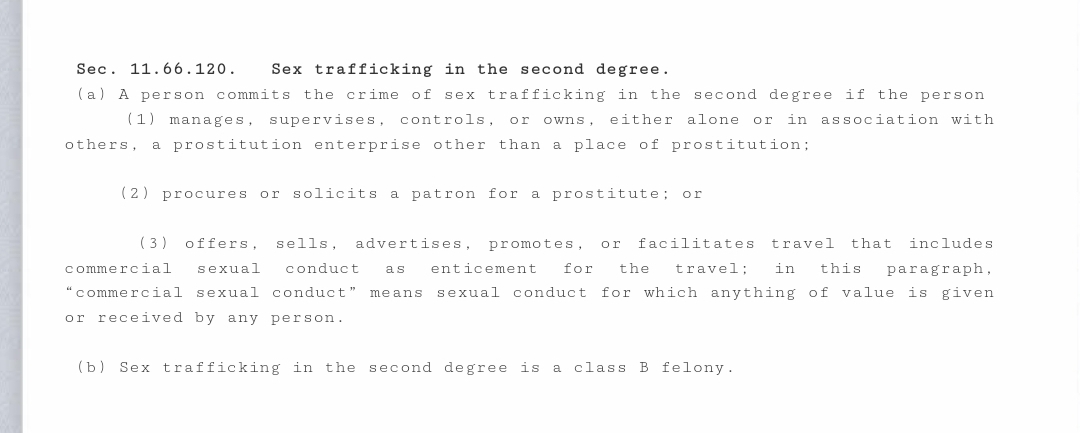
It makes sense for people convicted of sex trafficking in the first degree – most of that statute is what we traditionally think of as sex trafficking. Sex trafficking in the second degree is just things like sex workers traveling together or sharing clients – things that are done even more often by sex trafficking survivors than sex workers.

Here is a story about our member Amber being convicted of sex trafficking in the second degree under the travel part of the statute. More recently, a mother who was a victim of horrifically violent sex trafficking was charged in a similar way.

We need your help!

Email your opposition to all of our Alaska Senators! Ask them to vote no on HB 66 as long as Section 30 (page 24, line 9) includes Sex Trafficking in the Second Degree.

Senator.Bill.Wielechowski@akleg.gov;

Senator.Kelly.Merrick@akleg.gov;

Senator.Shelley.Hughes@akleg.gov;

Senator.David.Wilson@akleg.gov;

Senator.Bert.Stedman@akleg.gov;

Senator.Jesse.Kiehl@akleg.gov;

Senator.Gary.Stevens@akleg.gov;

Senator.Jesse.Bjorkman@akleg.gov;

Senator.Cathy.Giessel@akleg.gov;

Senator.James.Kaufman@akleg.gov;

Senator.Elvi.Gray-Jackson@akleg.gov;

Senator.matt.claman@akleg.gov;

Senator.Forrest.Dunbar@akleg.gov;

Senator.Loki.Tobin@akleg.gov;

Senator.Mike.Shower@akleg.gov;

Senator.Scott.Kawasaki@akleg.gov;

Senator.Click.Bishop@akleg.gov;

senator.robert.myers@akleg.gov;

Senator.Lyman.Hoffman@akleg.gov;

Senator.Donald.Olson@akleg.gov;

IMMUNITY CATCHES KILLERS

Amber Nickerson, a member of CUSP, wrote this about the immunity to report after attending the Brian Steven Smith trial in Anchorage, Alaska Feb. 2024.

I have been a sex worker in Alaska for 20 years. I started in 2004, leaving an abusive marriage because I could support myself and my two kids from my work. I have experienced stigma, shame and criminal charges due to being a sex worker.

My first day attending Brian Steven Smith’s trial was on Valentine’s Day. A fitting day, the five-year anniversary of when Tracy Lynn Day, an Indigenous woman from Juneau and my longtime best friend, became missing. I went to the trial to show support to the family of other women, who Smith was accused of murdering, and to witness the ending of a predator. I wanted to find the courageous woman that came forward and initiated the investigation, a woman the media described as a “convicted prostitute.”  When the media describes a person like this it dehumanizes and promotes stigma, and this makes sex workers easy prey for men like Smith.

Brian Steven Smith’s trial was for the murders of Kathleen Jo Henry and Veronica Abouchuk, two homeless Alaska Native women he picked up for sex. He regularly picked up sex workers. Smith had picked up Valerie Casler, a sex worker, and she stole his phone. She found images and video of the murder of Kathleen Jo Henry, in all of its horror, on that phone. 

Fearful of arrest, she transferred the videos to an SD card and contacted the Anchorage Police Department on Sept. 30, 2019, stating she had found the SD card in the parking lot. She was afraid of being arrested for theft of Smith’s phone and of prostitution. Both misdemeanors. 

She was afraid of being arrested for a moral crime when she had information about a horrific murder. 

The videos of the torture and murder initiated an investigation from APD. Officers recognized Smith’s accent from a prior investigation, when a woman named Alicia Youngblood had contacted the police in 2018 regarding Smith. 

Alicia Youngblood had a brief previous relationship with Smith and had contacted police in 2018 after he had made comments to her about killing a woman. Not much is mentioned regarding that investigation. We were told that Youngblood had testified for the grand jury in this trial, but sadly in July of 2021 she died.

Casler didn’t know that sex workers have immunity from prostitution charges when reporting heinous crimes, thanks to the work and effort of Community United for Safety and Protection addressing the issue and getting the prostitution statute modified in 2016 as part of SB91. Encouraging victims and witnesses to come forward and report violent predators in our communities is important. Letting the public know this is even a viable option is part of stopping serial killers like Brian Steven Smith. 

Clients of sex workers don’t have the same immunity from prostitution charges to report heinous crimes. Clients are first responders in cases of actual sex trafficking and can be the only people a trafficking victim is ever alone with to confide in, but they risk an embarrassing charge and news coverage that could have long-term effects on their careers and families if they report crimes like sex trafficking or murder. This year in House Bill 265, legislators are considering modifying the immunity section of the prostitution statute and they could choose to add clients into its protections. 

If more people knew that sex workers could report crimes without fear of legal repercussions it could answer lingering questions left after Smith’s trial. 

For example, there was unknown female DNA found on the tailgate of Smith’s Ford Ranger. An FBI DNA forensic examiner from Quantico testified that DNA evidence ruled out Veronica Abouchek and Kathleen Jo Henry. Swab samples from Stephanie Bissland, Smith’s wife, were sampled, compared and excluded. The female DNA was possibly from another victim. 

On Feb. 22, 2024, the jury deliberated for close to two hours and came back with their verdict. Smith was found guilty on all 14 counts, including an aggravator that Smith subjected Kathleen Jo Henry to substantial physical torture. Fortunately, Casler’s fear of police and the resulting chain of custody of the videos was only a small hiccup the defense focused on. 

I met up with Valerie Casler the day after. It turns out, Feb. 22 was her birthday. When I told her of the verdict she looked at me and smiled. “The DA said they would call me, I didn’t know!” she laughed, nodding her head.

“I’d do it again, ‘cause those ladies needed to cross over and their souls make it to heaven,” she said. 

Valerie knows she saved lives. She knows she stopped a serial killer from killing more Alaska Native women and sex workers. 

Sentencing is set for July. 

SAFETY ALERT

During the recent serial killer trial of Brian Steven Smith disturbing information came out about IAN CALHOUN. We believe he is a DANGER to sex workers and Alaska Native women. Be aware and stay safe!

ADDITIONAL INFORMATION

‘I have something to show you’: Smith texted Anchorage man in hours after hotel room killing, met him at Hillside park – ADN

In one text, the detective said that Calhoun texts Smith: “I was not up, sounds like you were having a lot of fun.”The detective said Smith replied: “I did have fun. Wanted to share.” Alaska Newsource

During the trial, prosecutors showed texts between Calhoun and Smith, which indicate that Smith wanted to show him Kathleen Henry’s body, before he disposed of it along the Seward Highway. Alaska Public Media

Who can you contact? CALL FOR THE DISTRICT ATTORNEY TO PRESS CHARGES!

Brittany Dunlop and Heather Nobrega (907) 269-6300

What can you do? Save and share the safety alert, call your representative and senator to let them know how you feel about Ian Calhoun not being held accountable. Find your rep/senator here.

Join in and have your voice heard! There are protests happening in Anchorage calling for the arrest and further investigation into Ian Calhoun. Find us on FACEBOOK and stay up to date on future protests.

SIGN THE PETITION! We have over 600 signatures! You do not need to donate, just sign, share, and help our community hold Ian Calhoun accountable.

We are calling on the Anchorage Police Department and the Anchorage District Attorney’s Office to arrest Ian Calhoun immediately for his involvement with convicted murderer Brian Steven Smith. Ian was in communication with the murderer and appears to have had firsthand knowledge of the crimes committed by Brian Steven Smith and he did not report them to authorities.

Feel free to print the flyer below out and share with your community.